
Paint Correction: Swirl & Scratch Removal
Machine polishing that removes swirl marks, water spots, oxidation, and buffer trails from your clear coat. Honest about what corrects out and what doesn't, done at your location.
Paint Correction: Swirl & Scratch Removal
Your paint has swirl marks, water spots, or a dull, hazy finish, and you want the gloss back. That is what paint correction does: machine polishing that levels the top of your clear coat to remove the fine scratches scattering light across the surface. Drippy Suds does it mobile, at your home, office, or apartment lot in the Sacramento metro, and owner Harvey Alvarez runs every job personally. Here is the part most detailers won't say plainly: paint correction removes some defects and cannot remove others, and you deserve to know which is which before you pay for anything.
What Paint Correction Actually Removes (And What It Can't)
Paint correction is machine polishing that removes a microscopically thin layer off the top of your clear coat to level out the defects sitting in it. Think of clear coat as a stack of clear film over your color. Most of the ugliness people want gone lives in the very top of that film. Level the top, and the scratches disappear because there is no longer an edge to scatter light.
Here is the split, drawn from what we see on Sacramento cars every week.
What machine polishing removes:
- Swirl marks and spider-webbing, the fine circular scratches from wash mitts, dry towels, and automatic brushes
- Buffer trails and holograms left by a previous careless polish job
- Light to moderate oxidation, the chalky flatness UV bakes into neglected paint
- Hard-water spots and mineral etching, provided the etch hasn't gone all the way through
- Light clear-coat scratches that your fingernail glides over without catching
What machine polishing cannot remove:
- Any scratch your fingernail catches in, because that has cut through the clear coat and polishing further would remove clear you can't replace
- Rock chips down to primer or metal, which are touch-up or body-shop repairs
- Deep gouges, key scratches, and scrapes through the color coat
- Damage under a ceramic coating without first correcting, then re-coating
The fingernail test settles most arguments. If your nail catches, we're honest with you: that one isn't coming out with a polisher, and we won't chase it at the cost of your clear coat.
The reason we lead with the limits instead of the promises is simple. A correction that over-thins clear coat to chase one deep scratch trades a small flaw you barely notice for a paint failure you'll definitely notice in a couple of Sacramento summers. We measure, we polish only what the paint can give up safely, and we stop there.
We come to your home, workplace, apartment lot, or wherever the vehicle is parked, so your car gets handled without rearranging your day.
Book NowWhy Swirl Marks Show So Badly on Sacramento Cars
Swirl marks are not caused by the sun, but the Sacramento sun is the reason you finally see them. The Central Valley averages more than 260 sunny days a year, and direct overhead light is exactly the condition that makes clear-coat scratches light up. A swirl-covered hood can look fine in a shaded garage and look like a spiderweb the moment you pull into a parking lot at noon. Drivers in cloudier regions carry the same swirls and never notice them. Here, you notice.
Local pattern we see: the worst swirl damage we correct comes off cars washed at the 16th Street tunnel and other automated washes around the metro. Those brushes drag grit from every previous car across your clear coat, and after a few years of weekly passes the finish is uniformly hazed.
Two other Sacramento-specific stressors build the defects that correction removes. Hard water is the first. Denver-style softness this is not, and mineral-heavy sprinkler and well water, common on Fair Oaks ranch properties, leaves calcium spots that etch into hot clear coat if they dry in the sun. The second is UV oxidation, which turns red, black, and dark-blue paint chalky and flat faster here than almost anywhere. Both of those are correctable while they sit in the clear coat, and both become permanent if they etch all the way through. That timing is the whole reason not to wait.
If your paint looks flat, hazy, or webbed in direct light, call 916-507-4802 and Harvey will assess whether it is correctable before quoting anything.
Inside the service
How to Buff Out a Scratch on a Car: The Honest DIY Answer
Most of what the internet tells you about buffing out a car scratch will make your paint worse, and we spend real time correcting DIY damage. So here is the straight version, including when to leave it alone.
First, run the fingernail test. Drag a fingernail gently across the scratch. If your nail does not catch, the scratch is in the clear coat and is a candidate for polishing. If your nail catches, it has cut through the clear coat, and no amount of buffing will remove it without cutting away clear coat you cannot replace. That single test saves people from ruining their paint chasing a scratch that was never going to polish out.
The three ways people try to buff a scratch, and how they actually go:
1. Scratch-remover paste by hand. Fine for one shallow scratch in a small spot. It is mild abrasive, and it works on light clear-coat marks. It will not touch anything your nail catches, and applied over a wide panel by hand it just creates uneven haze.
2. A cheap rotary buffer from a hardware store. This is where DIY jobs go wrong. A rotary in untrained hands burns through clear coat at edges and body lines in seconds, leaves swirl marks and holograms worse than the ones you started with, and generates heat that can lift paint. We correct these more often than we'd like.
3. A dual-action polisher with the right pad and compound. This is the tool that actually does controlled correction. It is also the tool that takes practice, the correct pad-and-compound pairing for your specific paint hardness, and the judgment to know when to stop. That judgment is most of what you pay a professional for.
The line we'd draw: one shallow scratch, hand paste is reasonable. A whole hood of swirls or anything approaching a rotary buffer, stop and get an assessment. Clear coat does not grow back, and there is a finite amount of it to work with.
If you've tried the paste and the haze is still there, or you're staring at a rotary buffer wondering if you should, call 916-507-4802 first. Harvey will tell you honestly whether it's a DIY job or a correction job.
Removing Swirl Marks From Tunnel and Automatic Car Washes
The single most common paint-correction job we do in the Sacramento area starts the same way: a driver ran their car through an automatic tunnel wash every week for a few years, and now the paint looks permanently hazed. That haze is swirl marks and spider-webbing, and here is the mechanism, because understanding it is what stops it from coming back.
Automatic brushes and cloth strips pick up grit, sand, and metal particles from every car that went through before yours. Then they drag that abrasive load across your clear coat at speed. Each pass lays down thousands of tiny scratches. One wash you won't see it. A hundred washes and the whole car scatters light in every direction, which reads to your eye as a dull, swirled, milky finish. Touchless washes skip the brushes but strip your wax and sealant with harsh chemistry, so the paint sits unprotected and scratches even easier at the next contact wash.
Paint correction removes those swirls by leveling the clear coat back to a uniform surface. But correction is only half the fix. If you go back to the tunnel wash the next week, the swirls come back on schedule. That is why we pair every correction with the same honest advice: switch to a proper hand wash so the correction actually lasts. Our exterior wash uses the two-bucket method specifically to avoid re-introducing the swirls we just removed.
Correcting a car and then sending it back through the tunnel is money down the drain. We'd rather you keep the finish than re-book the same job next year.
Book a paint correction and Harvey will assess the swirl depth in person, or send clear photos in direct sunlight to 916-507-4802 for an honest first read.
How Paint Correction Works, Step by Step
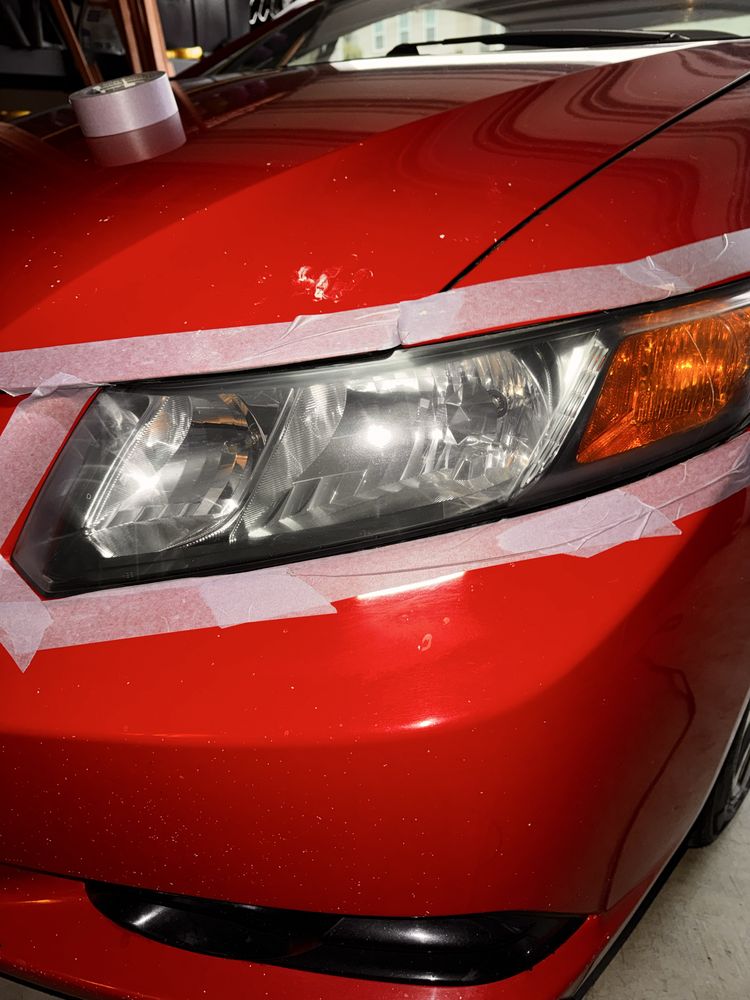
Correction is a controlled process, not a single buff-and-go pass.
Here is exactly how a Drippy Suds correction runs so you know what the time and the quote actually cover.
1. Assessment in real light. We look at the paint in direct sun or under correction lighting, run the fingernail test on the scratches that bother you, and separate what's correctable from what isn't. You get the honest split before anything starts.
2. Decontamination wash. A proper hand wash, then a clay bar or iron treatment to pull embedded grit and rail dust out of the clear coat. Polishing over embedded contamination just grinds it into the paint, so this step is non-negotiable.
3. Test spot. We correct a small test section first to confirm the right pad-and-compound combination for your specific paint hardness. Every paint responds differently, and guessing is how shops burn clear coat.
4. Machine polishing. Working panel by panel with a dual-action polisher, we level the clear coat to remove swirls, oxidation, and light defects. Single-stage for lightly marked paint, multi-stage for heavier correction where a cutting pass is followed by a refining pass.
5. Refine and inspect. A finishing pass removes any haze the correction step left, and we re-inspect each panel under light to confirm the defects are actually gone, not just hidden by polishing oils.
6. Protect. Correction removes a thin layer of clear coat, which means the fresh surface needs protection. This is the natural moment to add a sealant or step up to a ceramic coating so the corrected finish is shielded from the next round of UV and contamination.
The whole thing takes hours, not minutes, and the time scales with paint condition and vehicle size. A light single-stage polish on a clean sedan is a shorter appointment. A multi-stage correction on a neglected SUV is a full commitment. We give you a realistic window when we quote.
When Paint Correction Is the Wrong Call
We'd rather lose the booking than take money for a job that won't help you. Paint correction is the wrong service in a few specific situations, and here they are plainly.
- Don't book correction if the damage is through the clear coat. Deep key scratches, rock chips to primer or metal, and anything your fingernail catches hard in are touch-up or body-shop repairs. Polishing can't rebuild clear coat that's gone, and forcing it just thins the surrounding paint.
- Don't book correction on a lease you're returning soon. If the car goes back in a few months and the swirls are minor, the money is better kept in your pocket. A normal detail and wash will handle the appearance for the time you have left.
- Don't book full multi-stage correction if a one-step enhancement is all the paint needs. Some lightly swirled daily drivers only need a single polishing pass to look dramatically better. Paying for aggressive multi-stage correction on paint that doesn't need it removes clear coat for no reason. We'll steer you to the lighter option when that's the honest call.
- Don't correct paint you plan to keep abusing. If the car is going straight back to the weekly tunnel wash, correction is a temporary fix at best. Fix the wash habit first, or the swirls return within months.
Straight talk: if your last real detail was recent and the paint only has a couple of shallow marks you notice in the sun, you may not need correction at all yet. Ask us and we'll tell you.
Honest answer
What Affects the Cost of Paint Correction
There is no fixed price for paint correction because two cars in the same driveway can be completely different jobs. What actually moves the number, so you understand the quote instead of just receiving it:
- Paint condition. This is the biggest factor by far. Light swirls that come out in one polishing pass are a fraction of the work of deep, uniform hazing that needs a cutting pass and a refining pass on every panel. The worse the paint, the more passes, and the more time.
- Vehicle size. A coupe and a three-row SUV are not the same surface area. More panels, more glass, more square footage of clear coat to work, and the correction time scales with all of it.
- Paint color and hardness. Dark colors show every defect and demand a more thorough finish. Paint hardness varies by manufacturer, and harder clear coats take more work to level. We confirm both with a test spot before quoting the full job.
- Single-stage versus multi-stage. A one-step enhancement polish is far less work than a two- or three-stage correction. Part of the assessment is figuring out the least aggressive process that actually solves your problem, because over-correcting wastes clear coat and your money.
- Protection add-on. Correction leaves fresh, unprotected clear coat, so most customers add a sealant or a ceramic coating in the same appointment. That's an additional service with its own cost, and combining it with correction is more efficient than two separate visits.
To get a real number for your specific vehicle, call 916-507-4802 or send clear photos taken in direct sunlight. Harvey will give you a straight assessment and an honest quote with no surprises at the door.
Finding Local Paint Correction in the Sacramento Metro
When you're looking for paint correction close to home, the mobile model solves the biggest problem with the service: most shops want your car for a full day or overnight, which means arranging a ride and losing access to your vehicle. Drippy Suds brings the correction to you across the Sacramento metro, so the car stays in your driveway or office lot the whole time.
We cover Sacramento, Elk Grove, Folsom, Roseville, Citrus Heights, Natomas, Rancho Cordova, West Sacramento, Carmichael, Fair Oaks, Arden-Arcade, and North Highlands. From Land Park bungalows to family SUVs in Elk Grove to ranch-property cars in Fair Oaks dealing with hard-water spotting, the correction work is the same careful, measured process at your address.
Mobile means Harvey brings power, lighting, and every product needed. You provide a location and vehicle access. No shop drop-off, no waiting room, no losing your car for a day.
One note on lighting: serious multi-stage correction benefits from controlled conditions, so for heavily damaged paint Harvey may recommend working in your garage or a shaded, covered space rather than open sun. He'll tell you what your specific job needs when he assesses it.
Ready to get the gloss back? Call or text 916-507-4802, or book online, and Harvey will come to you.
Frequently Asked Questions
- Does paint correction remove scratches?
- It removes some scratches and not others, and the difference is whether the scratch is in the clear coat or through it. Run your fingernail across the scratch: if it glides over without catching, the scratch lives in the clear coat and machine polishing can level it out. If your nail catches, the scratch has cut through the clear coat to the color or primer below, and no amount of polishing removes it, because correction works by removing a thin layer of clear coat, not by filling damage in. Deep scratches like that are touch-up or body-shop repairs. Drippy Suds runs the fingernail test at the assessment and tells you honestly which of your scratches are correctable before quoting anything.
- Can you buff out deep scratches?
- No, and any detailer who says yes is either misunderstanding the damage or willing to over-thin your clear coat to make a sale. A deep scratch has gone through the clear coat. Buffing removes clear coat rather than adding it, so the only way to level a deep scratch by polishing would be to grind away all the clear coat around it, which ruins the panel. Deep scratches, key marks, and rock chips down to primer are repaired with touch-up paint or body-shop refinishing, not correction. If your fingernail catches in the scratch, it is too deep to buff out safely.
- What is the difference between paint correction and ceramic coating?
- They do opposite things and work together. Paint correction fixes what's already wrong with the paint: it's machine polishing that removes swirl marks, oxidation, water spots, and light scratches sitting in the clear coat. Ceramic coating protects the paint going forward: it's a liquid polymer that bonds to the clear coat and adds UV resistance, hydrophobic water behavior, and gloss for two to five years. The right order is correction first, coating second. There's no point locking imperfections under a coating, so you correct the paint to make it look its best, then coat it to protect that finish. Many customers book both in one appointment because combining them is more efficient than two visits.
- How much does paint correction cost?
- There's no flat price, because paint condition is the entire job and it varies enormously between vehicles. A light single-stage enhancement polish on a maintained daily driver is a fraction of the work of a multi-stage correction on a neglected black SUV covered in tunnel-wash swirls. Vehicle size, paint color, paint hardness, and how many polishing passes the defects require all move the number. Anyone who quotes a firm price over the phone without seeing the paint is guessing. Call 916-507-4802 or send clear photos taken in direct sunlight and Harvey will give you an honest assessment and a straight quote.
- How long does paint correction last?
- The correction itself is permanent in the sense that the swirls and defects are physically removed, not hidden. They won't come back on their own. But your paint is still exposed to whatever caused the original damage, so new swirls can appear if you go back to automatic tunnel washes or dry the car with a dirty towel. That's why we pair correction with two things: a switch to proper two-bucket hand washing, and a sealant or ceramic coating to protect the freshly corrected surface. Correct it, protect it, and wash it correctly, and the finish holds for years.
- Is paint correction the same as buffing?
- Buffing is a loose term people use for anything from a wax pass to aggressive machine polishing, so it causes a lot of confusion. Paint correction is a specific, controlled process: assessment, decontamination, a test spot to find the right pad and compound for your paint, machine polishing panel by panel, a refining pass, and inspection under proper light. The dangerous version of buffing is a cheap rotary buffer in untrained hands, which burns through clear coat and leaves holograms worse than the original defects. Correction done right uses a dual-action polisher and stops before removing more clear coat than the paint can safely give up.
- Do you offer mobile paint correction, or do I have to bring my car in?
- It's fully mobile. Drippy Suds brings the correction to your home, office, or apartment lot anywhere in the Sacramento metro, so you don't lose your car for a day or arrange a ride to a shop. Harvey brings power, correction lighting, and every product needed. For heavily damaged paint that needs serious multi-stage work, he may recommend working in your garage or a shaded covered space rather than open sun, since controlled lighting matters for that level of correction. He'll tell you what your specific job needs at the assessment.
We Also Serve
Related Services
Get the gloss back. Call or text Harvey at 916-507-4802 for an honest paint-correction assessment before any work starts.
Book Now