
Are Tunnel and Touchless Car Washes Safe for Your Paint?
The honest answer almost no car wash will give you: tunnel brushes scratch your clear coat every single visit, and touchless chemistry strips your protection.
Here is the answer no automatic car wash is going to volunteer: a tunnel wash scratches your paint every single time you roll through it, and a touchless wash strips the protection right off your clear coat with the chemistry it uses to clean. We're detailers, not a car wash, so we have no reason to soften that. If you've been running your car through the tunnel on 16th Street every couple of weeks and wondering why the finish looks duller than it used to, this is why. The good news is the fix is simple, and it isn't expensive.
Most of the damage is invisible until the right light hits it. That's exactly why automatic washes get away with it. You drive out with a car that looks clean, the water beads off, everything seems fine. The harm is microscopic and cumulative, and it only shows up as a haze of fine circular scratches once you park in direct Central Valley sun a year or two later. By then the wash that caused it is long forgotten.
Are Automatic Car Washes Bad for Your Car?
Yes, tunnel washes are genuinely bad for your paint, and the reason is mechanical, not a matter of opinion.
The brush problem. Those spinning brushes and cloth strips touch hundreds of cars a day. They pick up embedded dirt, grit, sand, and even metal particles from every vehicle that went through before yours, then drag that abrasive load across your clear coat at speed. Each pass leaves micro-scratches. One wash is invisible. A year of weekly tunnel visits is a visible haze.
What that haze is called. Detailers call it swirl marks or spider-webbing. Look at a dark-colored car under direct sunlight and you'll see fine circular scratches radiating out from a light source. That pattern is almost always from automated washing, not from age or normal driving.
Why Sacramento makes it worse. Our cars carry more abrasive grit than most. Valley oak pollen, agricultural dust drifting in from around Rancho Cordova, and fire-season ash all settle onto paint between washes. Push a tunnel brush over that and you're sanding the clear coat, not cleaning it. The damage compounds faster here than it would in a wetter, cleaner climate.
The cheap price on the marquee is the trap. Four dollars a wash feels like a deal until you realize you're paying for it later in a flat, swirled finish that knocks real money off the car's resale value. We'd rather you hear that now than discover it the day you try to trade the car in.
Do Touchless Car Washes Damage Paint?
Touchless washes solve the scratching problem and create a different one. Because nothing physically touches the paint, there are no brush-induced swirl marks. That part is a real improvement over a tunnel.
The catch is in how a touchless wash gets your car clean without contact: it relies on aggressive, highly alkaline chemicals to break dirt loose so high-pressure water can blast it off. Those same chemicals don't distinguish between road grime and the protection on your paint. Every touchless cycle strips wax, spray sealant, and the hydrophobic top layer of a ceramic coating right along with the dirt.
- No swirl marks because there's no brush contact, which is the one genuine advantage over a tunnel.
- Zero protection left because the alkaline chemistry strips wax and sealant on every pass.
- Water spots within days since unprotected paint holds mineral-laden water instead of shedding it.
- Accelerated coating wear if you've invested in ceramic, because repeated alkaline exposure shortens its real-world life well below the advertised window.
So a touchless wash is the lesser of two evils for short-term paint integrity, but it leaves you with a clean car that's completely defenseless against the next round of UV, sap, and contamination. In a market with over 260 sunny days a year, defenseless paint doesn't stay glossy for long.
Hand Wash vs. Car Wash in Sacramento: What Actually Protects the Paint
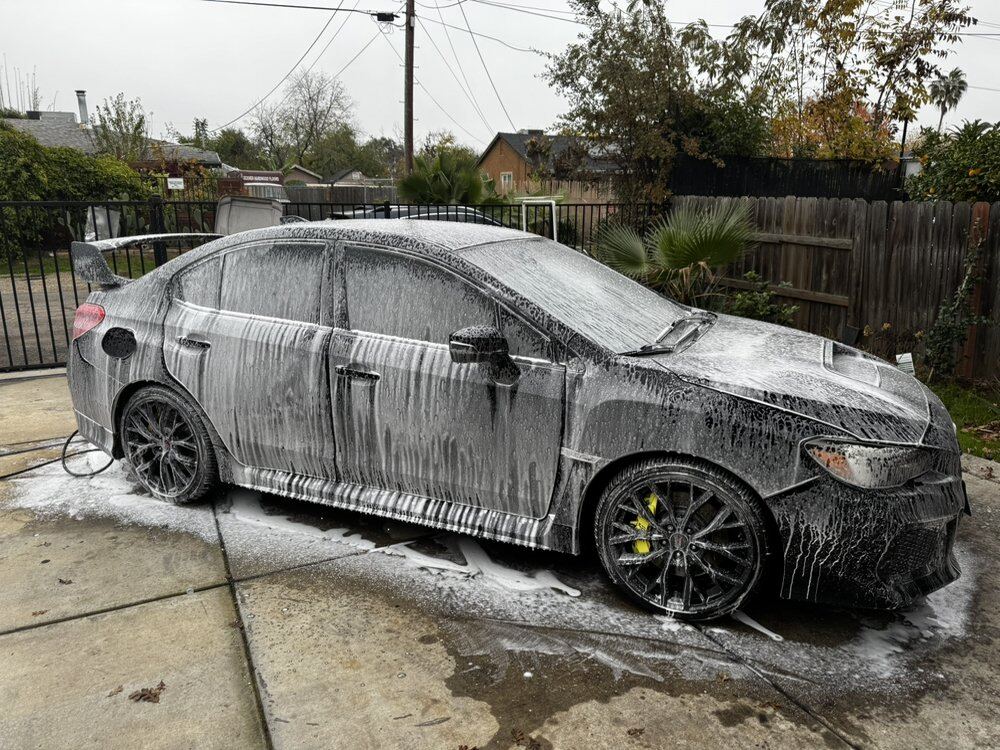
The honest comparison isn't tunnel versus touchless. It's automated versus done right by hand. A proper hand wash sidesteps both failure modes at once: no shared brushes dragging grit across your clear coat, and no paint-stripping alkaline bath.
Here's the discipline that makes a hand wash safe, the same process we run on every exterior we touch.
1. Pre-rinse first. A thorough rinse knocks loose surface grit before anything contacts the paint. Skipping this is how even careful hand washes cause scratches. 2. Two-bucket method. One bucket holds clean soapy water, the second holds plain rinse water. The wash mitt gets rinsed in the second bucket before every return to the paint, so the grit it just lifted never gets dragged back across the clear coat. That single step is the difference between cleaning the paint and scratching it. 3. pH-balanced soap. A dedicated car shampoo lifts dirt without the alkaline punch that strips your wax or sealant, so whatever protection you have survives the wash. 4. Controlled drying. Improper drying re-introduces the same micro-scratches a hand wash is meant to avoid, so the towel work matters as much as the wash itself.
This is the entire argument for our paint-safe two-bucket hand wash over the tunnel. It takes longer than four minutes in an automated bay, and that's the point. The extra time is where the paint protection actually happens. Ready to stop the swirl cycle? Call (916) 539-2062 and we'll come to your driveway anywhere in the Sacramento metro.
If You Already Have a Coating, the Wash Matters Even More
A common and expensive mistake: paying for ceramic protection, then maintaining it at the same automatic wash that works against it. Tunnel brushes scratch a coating exactly the way they scratch bare paint, and touchless alkaline chemistry eats away at the hydrophobic layer that makes a coating worth the money.
If you're considering long-term protection, the sequence matters: a proper wash comes first, then you add ceramic protection after a proper wash so the coating bonds to a genuinely clean surface. And once it's down, the coating only delivers its 2-to-5-year payoff if you keep washing the car by hand or with a contact-safe method. Run it through the tunnel and you'll undo what you paid for. If you park outside through a Roseville summer or leave the car under Folsom street trees, that protection plus a safe wash routine is the single biggest thing standing between your finish and a slow fade. Tell us how and where you drive and we'll give you the straight recommendation.
Frequently Asked Questions
What causes swirl marks on car paint?
Swirl marks are fine circular scratches in the clear coat, and the overwhelming cause is improper washing. Automatic tunnel brushes are the biggest culprit: they hold embedded grit from hundreds of previous cars and drag it across your paint at speed, leaving micro-scratches that accumulate into a visible haze over months. Hand washing without the two-bucket method causes the same thing by reloading the mitt with grit between panels. Drying with a dirty or rough towel adds to it. You typically only see swirl marks under direct sunlight, which is why Sacramento drivers notice them more from May through October.
Are touchless car washes safe for ceramic coatings?
They're safer than tunnel brushes, which physically scratch a coating, but they still aren't ideal. Touchless washes use strongly alkaline chemicals to clean without contact, and that chemistry degrades the hydrophobic top layer of a ceramic coating faster than a pH-balanced hand wash does. Occasional touchless use won't ruin a coating, but making it your only maintenance method shortens the coating's real-world life below the advertised range. A contact-safe two-bucket hand wash is what protects the investment.
Is a hand wash really worth it over a four-dollar automatic wash?
For anyone who plans to keep their car, yes. The automatic wash is cheap per visit but compounds into a flat, swirled finish that costs real money in lost resale value and eventually needs paint correction to fix. A proper hand wash costs more up front and doesn't damage the clear coat, so the paint keeps its gloss instead of slowly losing it. The value is clearest for drivers who've already watched swirl marks develop from years of tunnel washes and want to stop the cycle.
Reach Drippy Suds Mobile Detailing at (916) 539-2062 or drippysudsllc@gmail.com to book a contact-safe hand wash. We're fully mobile across the greater Sacramento area, first-time clients get $25 off, and every detail is backed by our satisfaction guarantee. If you're not completely satisfied, we'll make it right.
Not sure which one your car actually needs?
Tell us your vehicle, where you park, and how you drive. We'll give you a straight answer on whether wax, a sealant, or a ceramic coating is the honest fit. First-time clients get $25 off.
Rather just talk it through?
Call (916) 539-2062Topics